

Governance as Growth Infrastructure: Building Legal Foundations That Scale Without Slowing Teams Down
Mar 31, 2026
7 minutes, 42 seconds
In fast-growing businesses, the first real governance question rarely arrives in a board meeting. It arrives in the middle of execution. It shows up as a message from a commercial lead asking who can sign a deal, or as a procurement team asking whether a clause is acceptable, or as a senior hire discovering that the way decisions are made depends on which part of the organisation you ask.
When governance is treated as a topic to address later, the intention is usually to preserve speed. The outcome is often the opposite. The business still slows down because teams lose time to rework, repeated negotiation cycles, delayed financing, inconsistent approvals, and avoidable disputes.
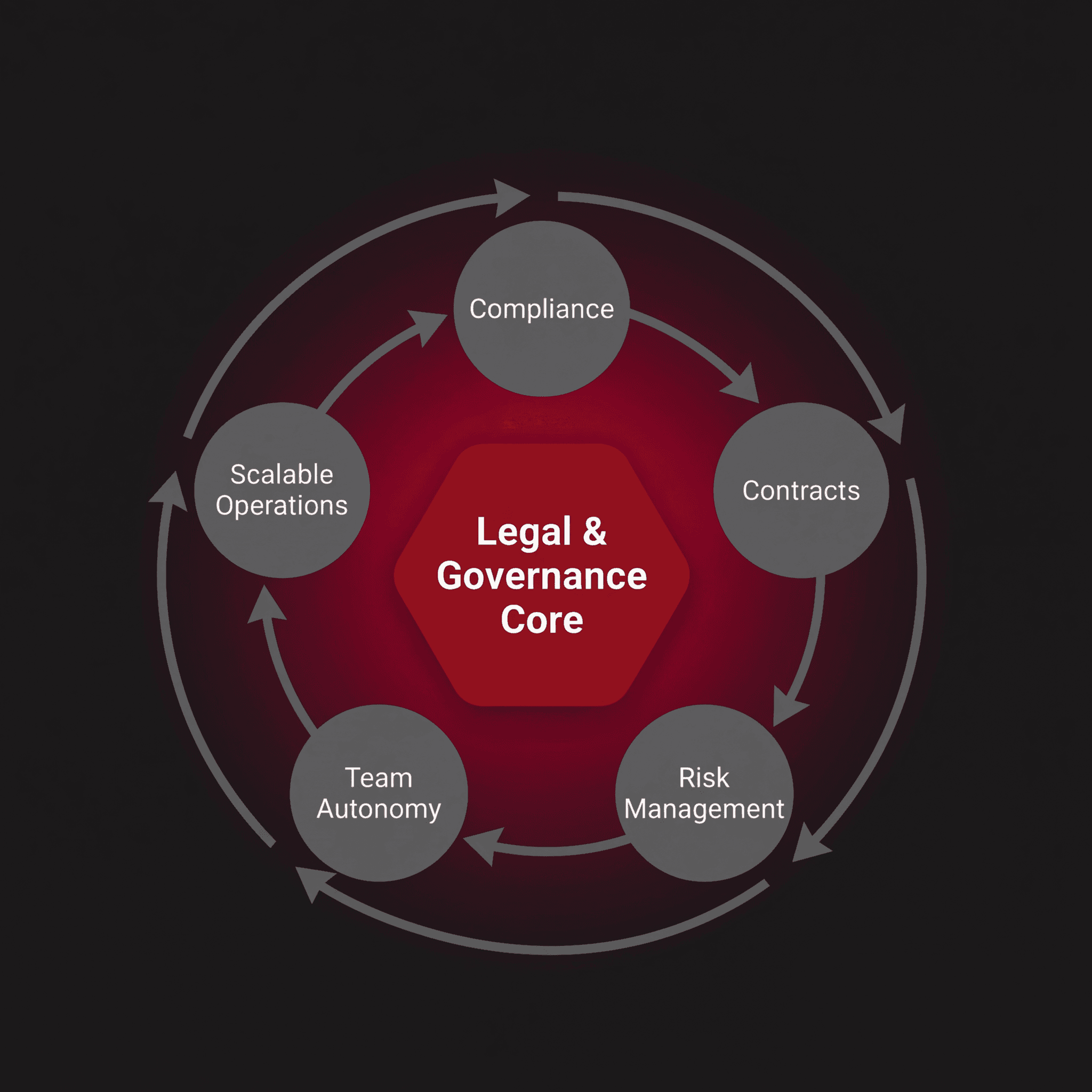
In scaling organisations, governance functions as a growth infrastructure that protects speed as complexity increases and strengthens investor confidence by making execution more predictable and by reducing avoidable risk. This article shares practical patterns and operating questions drawn from scaling environments. It is for general information and discussion only, and it does not constitute legal advice.
Why governance becomes a growth topic
Growth is a coordination challenge. As headcount, transaction volume, and geographic footprint expand, the number of decisions increases, and dependencies multiply. What was once manageable through founder context and informal alignment becomes harder to sustain.
This is often when the business pays a tax on speed. In some cases, the tax is commercial. Negotiations run longer because there is no shared baseline for terms, escalation, and approvals. In other cases, the tax is internal. Teams spend time negotiating with each other because decision rights are unclear, or because two parts of the business have different risk tolerances that have never been reconciled.
From the perspective of investors, lenders, and strategic partners, governance is also a signal of reliability. Stakeholders do not only assess the product and the market. They assess whether the business can operate predictably under pressure, and whether it can repeat good decisions at scale. Governance, when designed well, becomes one of the clearest ways to demonstrate that capability.
What legal infrastructure means in practice
Legal infrastructure is not a library of policies. It is the minimum structure that helps a business execute repeatably, particularly when leadership cannot be present for every decision.
I look for three outcomes. Clarity exists when people know who decides, who signs, and who is accountable. Consistency exists when similar decisions are made in similar ways, so teams do not reinvent the wheel on every transaction or process. Evidence exists when the company can show what it decided and why, which supports continuity, governance, and stakeholder trust.
When these outcomes are in place, many downstream processes become simpler. Examples include onboarding senior leaders, negotiating key commercial agreements, expanding into new jurisdictions, and preparing for diligence in connection with financing, acquisitions, or major partnerships.
A roadmap for right-sized governance
There is no single correct governance model. The goal is to add structure just ahead of the next inflection point, rather than adopting enterprise governance too early or accumulating governance debt for too long. A practical way to approach this is through a maturity roadmap that anchors governance to operating signals.
Stage one: Founder-led execution and early traction
This stage typically involves a small leadership team, low contracting volume, and decisions that can be made quickly with direct context. Governance should focus on essentials that prevent avoidable problems while keeping iterations fast.
For many companies, the essentials are straightforward. Ownership and control should be clean and well-documented. Intellectual property ownership should be clear, particularly where contractors and early team members contribute to core assets. Authority to sign should be understood, even if it is limited to a small set of people.
The objective here is not to build a governance framework. The objective is to avoid preventable ambiguity that becomes expensive later.
Stage two: Early scale and repeat transactions
Signals of this stage include functional leaders joining, an increase in sales or procurement activity, and more external counterparties requesting structured terms and formal approvals. This is when a simple delegation of authority becomes valuable, because it eliminates confusion about who can approve spend, hiring, and commercial commitments.
It is also when templates and a negotiation playbook begin to pay for themselves. A template not only saves drafting time, but it also sets a baseline for acceptable risk and creates a shared language for negotiation. It ultimately reduces variability, which helps the business learn faster from what works and what does not.
The objective in this stage is to keep the organisation moving quickly by standardising repeat work and by making escalation predictable.
Stage three: Multi-team execution across entities, products, or jurisdictions
Signals include cross-border activity, multiple business lines, or a group structure that requires clearer separation of roles and responsibilities. Leadership and legal can no longer be in every conversation, and informal alignment becomes less reliable.
At this point, governance needs to operate like an internal system. A consistent escalation path helps teams move fast on standard work while surfacing non-standard risk early enough to avoid late-stage surprises. Lightweight decision records start to matter more, not because they are bureaucratic, but because institutional memory becomes fragile as organisations grow.
The objective in this stage is to preserve momentum by replacing informal coordination with a repeatable operating model.
Stage four: Investor-grade and institutional readiness
Signals include significant external financing, acquisitions, complex strategic partnerships, or a stakeholder base that expects disciplined reporting and visible risk management. In this stage, governance extends beyond transactions and approvals. It becomes part of how the company steers.
Board and management reporting should be consistent and decision-oriented. Approvals and key decisions should be evidenced clearly. Risk discussions should be grounded in practical trade-offs rather than generic language. The result is reduced friction in diligence, higher stakeholder confidence, and fewer surprises in execution.
The objective here is not to look or feel corporate. The objective is to be credible, predictable, and resilient under pressure. This is about results, not the optics of your framework and the length and extent of your processes and procedures.
Timing the layers so governance supports speed
A layered approach helps avoid two common failure modes. One failure mode is adopting enterprise governance before the business needs it, which creates a process that teams route around. The other failure mode is ignoring governance until the cost of fixing it is highest, often during financing, audits, or disputes.
A practical way to right-size governance is to think in three layers: foundation, operating system, and strategic governance.
The foundation is needed early because it prevents ambiguity. It includes a clear entity and ownership picture, core governance documents that reflect reality, and a delegation of authority that is understood and used. The foundation also includes a basic calendar of recurring obligations and approvals, because missed governance steps tend to surface at the worst time.
The operating system becomes important once the business repeats the same transactions. It includes templates, playbooks, and escalation rules that match how the business actually sells, buys, hires, and partners. The operating system should reduce negotiation cycles and help teams self-serve within agreed parameters. It should also make it obvious when a deal or decision is truly non-standard.
Strategic governance becomes critical as external stakeholders increase and capital allocation becomes more complex. It includes a reporting rhythm, board pack discipline, and learning loops that translate execution experience into updated playbooks and standards. Its value is that it protects management time and reduces surprises, which is a material advantage in scaling environments.
Mechanisms that keep governance practical
Governance works when it is usable. A few mechanisms tend to deliver high impact with minimal bureaucracy.
A delegation of authority should be short enough to remember and clear enough to apply. It should cover spend commitments, hiring, commercial agreements, and any areas where the business handles sensitive data or core intellectual property.
Templates and playbooks should reflect the transactions the business actually does. The first version should prioritize adoption over perfection. A good test is whether teams voluntarily use the materials without needing reminders.
An escalation path should be predictable. People should know what is considered standard, what is considered non-standard, and what requires a pause for review. Predictability reduces friction because teams can plan and negotiate with confidence.
Decision records should be lightweight and purposeful. In many cases, a short approval note, a stored final agreement, and a clear record of the decision owner are enough. The goal is continuity and evidence, not documentation for its own sake.
Reporting should help make decisions. The most valuable reporting highlights what has changed, what is at risk, and what leadership needs to decide next.
Where companies get stuck
Some businesses overbuild too early by importing enterprise policies that do not match their maturity. The result is governance theatre. Documents exist, but behaviour does not change, and teams route around the process.
Other businesses underbuild for too long. Governance debt accumulates quietly and then appears suddenly when the cost of fixing it is highest. This can happen in diligence, during rapid expansion, or after a dispute exposes ambiguity that could have been prevented with clearer decision rights and documentation.
There is also a common mindset trap where legal is seen as the blocker. Review feels slow when expectations are unclear. Speed improves when the business has templates, shared negotiating positions, and agreed escalation rules. In that model, legal supports execution by reducing variability, not by inserting itself into every decision.
Closing reflection
In a holding company environment, governance also shapes the external narrative. It helps create confidence that decisions, approvals, and reporting are predictable across the group, while still allowing portfolio teams to execute in ways that fit their stage and market. Discipline without forced uniformity is often the right target.
Well-designed governance is not the opposite of speed. It is one of the ways to protect speed as complexity increases. At its best, it is governance by design, built into how decisions are prepared, escalated, and documented, and reinforced through a culture that values clarity and accountability. It should develop through experience and learning, adding structure in stages as the business matures, rather than imposing an overbuilt framework that teams will work around. Like any effective change management effort, the strongest models start small, are used in practice, and evolve deliberately in response to operating signals rather than abstract ideals.
By Brian Dunn, Group General Counsel, Mojay Holding