
Executive Summary
When people talk about investments and holdings, they usually focus on things like how to allocate capital or pick the right strategies and time the market. That stuff gets a lot of attention. But honestly, the quality of the teams actually putting those plans into action does not come up as much, even though it matters just as much, maybe more.
I think growth in portfolios does not really stop because there is no ambition or chances out there. It happens more when the team setup does not keep up as things get more complicated. Like, structures that worked fine at first just break down.
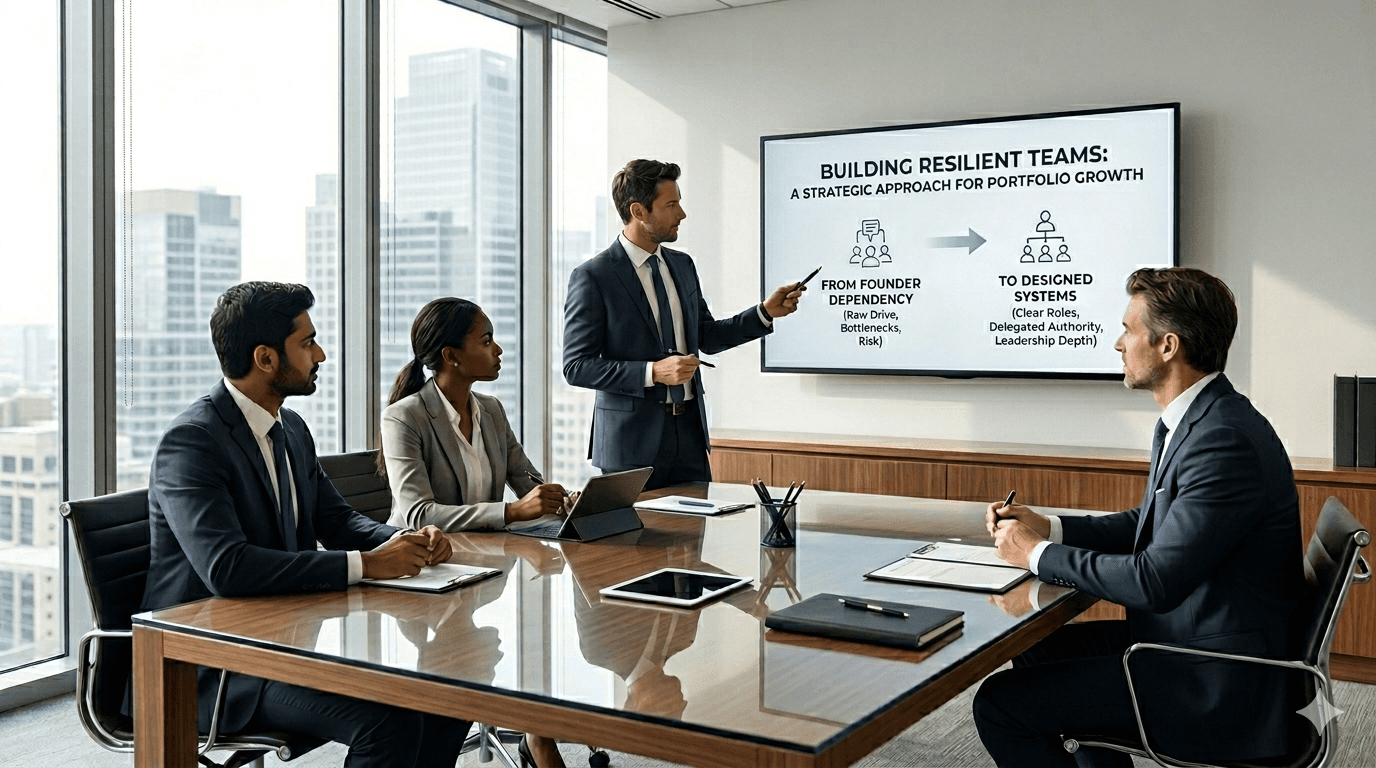
High-performance teams are not something that just shows up on its own. They take deliberate planning to set up systems that make roles clear, spread out who has authority, and develop deeper leadership. It seems kind of obvious once you say it, but it is not always done that way.
For investors or companies that hold onto other businesses, seeing team effectiveness as a real strategic part, not just some side thing to handle later, can cut down on risks when executing. It speeds up how fast they can grow too, and helps with better value over the long run. That part feels a bit messy to explain, but I am not totally sure how else to put it.
The Talent Challenge in Scaling Portfolio Companies
Portfolio companies usually kick off with a lot of that raw entrepreneurial drive. It is from a tight group of people, like the founders, who are super committed and end up wearing a bunch of hats while making calls on the fly. That setup carries them through the beginning stages pretty well.
But as things get bigger, it starts to feel shaky. The informal way of doing stuff just does not hold up when complexity piles on. Decisions drag out, it's hard to pin down who's responsible for what, and the leaders get buried under all the day-to-day mess. I think that's when you see these performance problems popping up, not in some big dramatic way, but more like little slips. Missed deadlines here, customer experiences that are not consistent, projects that just stall out, or even tension building inside the team.
From what investors see, this turns into a risk that is not obvious right away. The numbers might look solid for now, which hides the real issues in how the team is built. Without stepping in to fix it, those problems keep growing, and the company ends up leaning too much on just a few people. That limits how well it can keep scaling, or at least it seems that way. Some places manage to push through, others don’t, but it is kind of messy to figure out exactly when it tips over.
What “High-Performance” Really Means at Portfolio Level
High performance in investments, I think, really comes down to how the whole system works together instead of some big hero saving the day. It is more about the team having things like clarity and discipline, and they stay resilient no matter who shows up.
Everyone needs to know their role pretty clearly, like what they are supposed to do and what decisions they can make on their own. That ties into the bigger strategy somehow.
Accountability gets defined, too, so people own their results without it just being guessed at. Coordination between different parts of the team happens without always running up to bosses for every little thing.
Leadership is spread out, not just all at the top, which makes things stronger I guess.
As companies get older and more mature, what counts as high performance changes a lot. A startup team might focus on going fast, and that looks nothing like a big institutional group worrying about rules, growing big, and handling risks carefully.
Holding companies sometimes mess this up by not seeing the difference, so they push the wrong kind of expectations at stages where it does not fit. It seems like that leads to problems down the line.
Designing Team Structures That Scale
One of the most common mistakes that companies make in portfolios is assuming that team structures will evolve organically, when, in fact, scale requires design.
As organisational stages of growth change, the approach used to build the teams also changes.
Early Growth: Broadscope, quick decisioning, no hierarchy.
Expansion: Clear functional ownership, new layers of leadership.
Institutionalisation: Governance, succession planning, and leadership depth.
Common errors in structure are to advance exceptional individual contributors to management positions too soon, to overmanage the business too soon, or to leave professionalization too late, suffering performance declines as a result. All these decisions create friction in the long term.
Good holding companies assist portfolio leadership by offering frameworks that help clarify role definition, span of control, and leadership layering — in the absence of prescriptive models. The goal is not standardization or sameness, but consistency between strategy, structure, and people capability.
Leadership Depth vs. Founder Dependency
To be fair, founder-led organisations tend to produce remarkable early performance. However, over-reliance on one individual makes the organisation fragile because all decisions are made at the top, thereby limiting performance based on one individual’s ability.
Warning signs of unhealthy dependence can also include bottlenecks in decision-making, lack of leadership, and senior-level burnout, which eventually limit growth as well as create succession risks.
HR plays a significant role in addressing this issue by providing support to the growth of leadership bench strength. Leadership bench strength refers to the process of developing critical roles where authority can be delegated safely. Leadership depth is critical to survival and exit for investors. It is not a 'nice to have' but a necessity.
The Holding Company’s Role in Team Performance
The day-to-day management of people is under portfolio leadership. However, team effectiveness cannot solely be delegated. Holding companies have a role to step in at the system level.
Appropriate level of involvement:
Review of Leadership Capabilities in Key Positions
Evaluating Talent Concentration Risk
Supporting succession and development planning
Ensuring alignment between structure and strategy
The equilibrium is a fragile one. Excessive intervention undermines autonomy, while too little intervention risks perpetuating existing structural risks. When executed well, holding-level HR oversight can be a stabilizing influence to help portfolio CEOs execute with confidence.
Key Takeaways for Investors and Operators
High-performance teams are designed, not wished for. In investment holdings, HR is not a support function; it is a strategic facilitator of value creation and risk management. Scaling effective teams enables growth, sustainability, and valuation, while those that are not effective siphon it off.
By Dr. Mohamed Taher, Advisor, Talent Management, Mojay Holding